Guide
Are water filters worth it in the UK?
Often for taste and convenience, rarely as a health necessity, and only if you will keep up with the cartridges. The case is stronger if you buy a lot of bottled water and weaker if a jug in the fridge already does the job.
The short answer
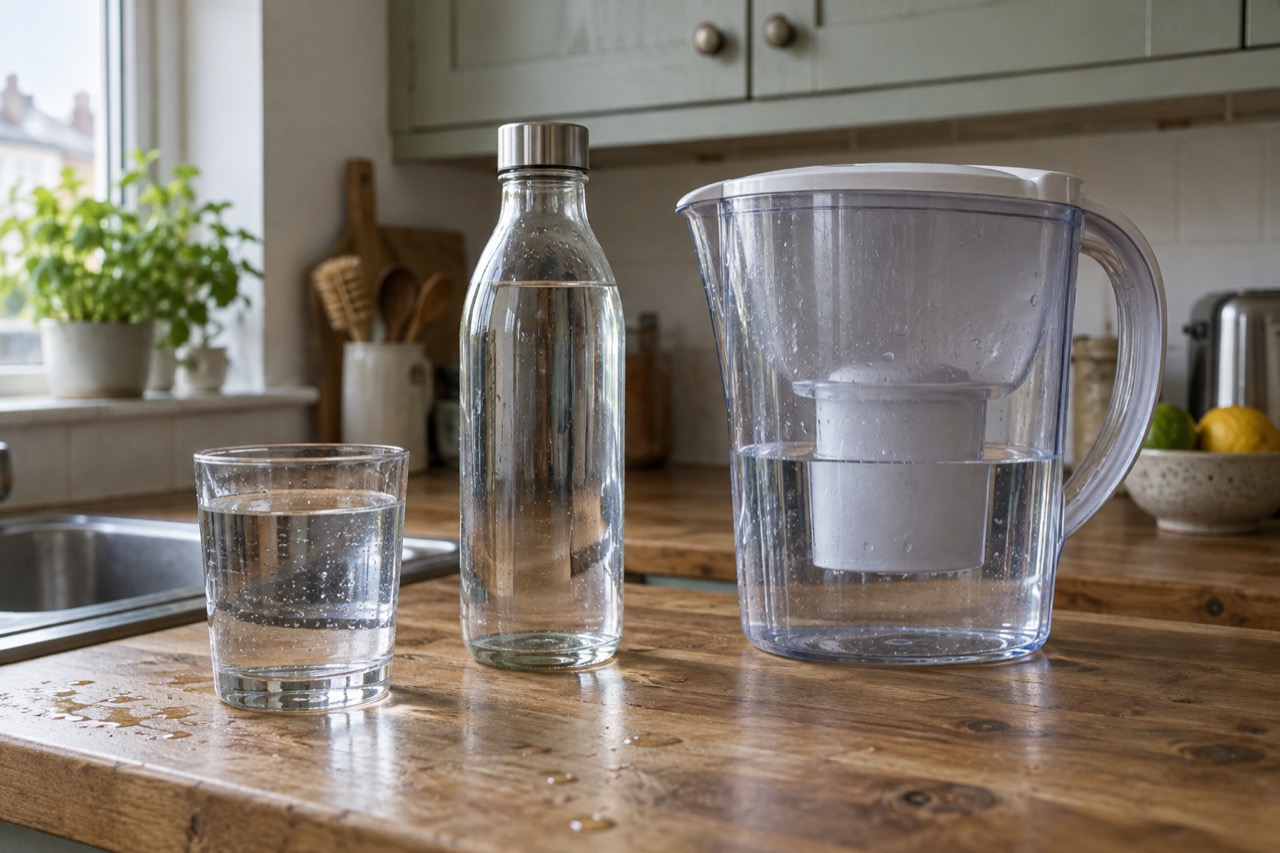
A water filter is worth it when it fixes something you notice, such as a chlorine taste or smell, or when it replaces bottled water you would otherwise carry home. It is not something most UK households need for their health. The Drinking Water Inspectorate, which regulates public water supplies in England and Wales, says mains drinking water generally needs no filter for health protection, and suggests starting with your water supplier’s quality report. It also points out that a chilled, covered glass jug is a cheaper way to improve taste. Read its guidance on domestic water filters and softeners.
That guidance is about public mains supplies. A private supply, or worries about the pipes in your own building, is a different question that a kitchen filter does not settle.
Who gets the most from one
| Your situation | Worth considering? | What to know |
|---|---|---|
| You dislike the chlorine taste or smell of your tap water | Often | Activated carbon is made for this. Try a chilled, covered jug first: it costs little if you already have one. |
| You buy bottled water for drinking | Often | Filtered tap water can replace some of it. The example below shows how to check the sums for your own household. |
| You want less limescale | Usually not a drinking filter | Scale is a hardness problem. See hard water and limescale before spending anything. |
| You rent | Often, if it needs no drilling | A jug or a refillable countertop filter needs no drilling or pipework. Tap-attached and plug-in types vary, so check the model. |
| You have a specific worry about your water | Start with your supplier’s report | A filter only helps if its verified claim covers that substance and you change it on time. How to check a claim. |
| You know you will forget the cartridge dates | Think twice | A cartridge past its rated life may no longer do what the maker claims. |
What it costs to run
The price on the box is only part of the cost. Add up:
- The filter itself, plus delivery and any tap, housing or adaptors it needs.
- Fitting, if the model needs a plumber. Under-sink systems often do; countertop ones usually do not.
- Cartridges, changed by time or by litres, whichever comes first. How change dates work.
- Extras you notice later: a second cartridge stage, a sanitising routine, or a part that wears out.
Cartridges keep coming round for as long as you own the filter.
A cost example: filter or bottled water?
Every figure here is invented to show the sums. They are not UK averages, and the result is not a promise of savings. The assumptions:
- The filter costs £120 to buy, with no fitting or delivery.
- It needs a £25 cartridge every six months, and the one fitted at purchase is included.
- The same household would otherwise buy 260 litres of bottled water a year at 50p a litre.
- Tap-water charges, electricity and repairs are left out of this example.
| After | Filter: purchase | Filter: paid cartridge changes | Filter total | Bottled water total |
|---|---|---|---|---|
| 1 year | £120 | £25 (1) | £145 | £130 |
| 3 years | £120 | £125 (5) | £245 | £390 |
| 5 years | £120 | £225 (9) | £345 | £650 |
The cartridge fitted at purchase is not charged again, so the first paid change is at six months. A change due exactly at the end of a year belongs to the next period, which is why the one-year total includes one paid change and the three-year total five. On these invented numbers the filter costs more in the first year and less by the third. Change any input and the answer moves: with fewer bottles bought, or dearer cartridges, the filter may never catch up. Put your own figures into the running-cost calculator.
Filter or softener?
They do different jobs. The Drinking Water Inspectorate explains that a softener, which uses sodium ion exchange, addresses hardness, and advises keeping the kitchen tap unsoftened for drinking and cooking. A drinking-water filter is bought for taste or a stated reduction, and most do nothing about scale. Our limescale guide sets out the difference and what a scale claim should tell you.
How to decide
- Name the problem. Taste, bottled-water spend, scale, or a specific worry. If it is a specific worry, read your supplier’s water-quality report first.
- Try the cheap fix. A chilled, covered jug costs little if you already have one, and it answers many taste complaints.
- Choose a format. Renting or short on cupboard space points to a countertop filter; owning and having room points to under-sink, and reverse osmosis is a bigger step with its own trade-offs. For water on the move, see filter bottles.
- Add up five years. Use the calculator with the exact model’s cartridge price and change interval.
- Check the claims. Match the maker’s claims to the exact model, as in our under-sink comparison of four systems.
Common questions
Do water filters remove limescale?
Mostly not. Taste filters use carbon, which is not aimed at hardness. Only a product with a verified hardness claim for the exact cartridge, or a softener, addresses scale. Examples from four real models.
Is a filter a health upgrade?
For public mains supplies in England and Wales, the inspectorate’s view is that it is generally not needed for health. A filter is not a general safety upgrade, and a claim only counts for the substances and the exact model it names.
How long do cartridges last?
By the model’s own time or volume limit, whichever comes first. Examples from named models are in the replacement guide.
Also weighing a boiling water tap? See are boiling water taps worth it?
General information, not advice about your own supply. How we check.